What Is a Birth Chart? A Complete Beginner's Guide
A birth chart maps the sky at the exact moment you were born. Here is what every part of it means, and how to read yours from scratch, no jargon.
Somebody once told you your star sign. That was one fact about the sky on the day you were born, the sign the Sun happened to be in. There were nine other bodies up there, twelve houses, and a horizon that shifts a full degree every four minutes. Your birth chart is all of it.
It is the difference between knowing a book's genre and actually reading the book.
This guide explains what a birth chart is, where the practice came from, what every symbol on it means, and how to read one line by line, starting from zero. By the end you will be able to open your own chart and understand what you are looking at.
The short answer
A birth chart, also called a natal chart, is a diagram of where the Sun, Moon, and planets were, as seen from your exact birthplace, at your exact moment of birth.
It needs three pieces of information:
| What | Why it matters |
|---|---|
| Date of birth | Sets the positions of the Sun, Moon, and planets against the zodiac. |
| Time of birth | Sets the Ascendant and the houses. The Moon also moves ~half a degree per hour. |
| Place of birth | Sets the horizon you are measuring from: the sky looks different from Leeds than from Lima. |
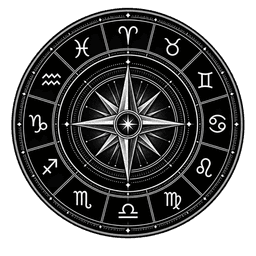
Feed those in and you get a wheel: twelve segments, a scattering of planetary glyphs, and a web of lines connecting them. That wheel is your chart. Everything else in astrology is interpretation of it.
Did you know? Astrologers call the exact moment your chart is cast the radix, Latin for "root." Every later technique (transits, progressions, returns) is measured as a change from that root position. Your birth chart is the fixed reference point everything else is compared against.
Where birth charts came from
Natal astrology is not a modern invention, and knowing its history makes the chart itself much easier to read, because most of what looks arbitrary is a fossil of something practical.
Babylon, c. 2000 to 400 BCE. Mesopotamian scribes kept meticulous records of celestial events and paired them with earthly ones, mostly for the state: omens about the king, the harvest, the war. Around the 5th century BCE the zodiac was formalised into twelve equal 30° segments: a bookkeeping convenience that made the sky arithmetically tractable. The oldest surviving individual horoscope dates to 410 BCE.
Hellenistic Egypt, c. 200 BCE to 200 CE. This is where the birth chart as we know it was assembled. Greek geometry met Babylonian record-keeping in Alexandria, and the result was the full apparatus: the Ascendant, the twelve houses, the aspects, the planetary rulerships. Claudius Ptolemy's Tetrabiblos (2nd century CE) systematised it well enough that it stayed the standard text for well over a millennium.
The Islamic Golden Age, c. 750 to 1200. Persian and Arab astronomers (Māshā'allāh, Abu Ma'shar, al-Bīrūnī) preserved, corrected, and considerably extended the Hellenistic material while European access to it lapsed. Much of the technical vocabulary still in use arrived in Europe through Arabic translation.
Medieval and Renaissance Europe, c. 1100 to 1650. Astrology re-entered Europe through those translations and became thoroughly institutional: taught at universities, practised alongside medicine, consulted by courts. Astrology and astronomy were not yet separate professions. Kepler cast charts. So did Galileo.
The split, c. 1650 to 1900. Newtonian mechanics gave astronomy a working physical model, and astrology, which had no equivalent, was pushed out of the academy. It survived in almanacs and popular pamphlets.
The modern revival, c. 1900 to now. The theosophist Alan Leo rebuilt astrology around character rather than prediction. Carl Jung's ideas about archetypes and synchronicity gave the 20th century a psychological vocabulary for it, and Dane Rudhyar's The Astrology of Personality (1936) turned that into a full method. This is the lineage most contemporary astrology descends from, which is why today's chart readings talk about who you are far more than what will happen.
That last shift matters for how you should read your own chart. The modern natal chart is a symbolic and reflective tool, not a forecasting instrument. It is closer to a mirror than a weather report.
The parts of a birth chart
Every natal chart is built from four ingredients. Learn these four and you can read any chart in front of you.
- The planets: what is happening. A drive, a function, an appetite.
- The signs: how it happens. The style or flavour it takes.
- The houses: where it happens. Which area of life it plays out in.
- The aspects: how the parts talk to each other. Cooperation, friction, blind spots.
A single line of chart interpretation is usually just those first three stacked together:
Mars (drive, assertion) in Libra (through negotiation, fairness, other people) in the 10th house (career, public standing). → Someone who pushes ahead professionally by building consensus rather than by force, and who may find direct confrontation at work genuinely uncomfortable.
That is it. That is the grammar. Everything else is vocabulary.
1. The planets: what is happening
Astrology uses ten bodies. Strictly, two of them are not planets (the Sun is a star and the Moon is a satellite), but the tradition calls all ten "planets," from the Greek planētēs, "wanderer," because they move against the fixed stars.
| Planet | Governs | One-word gloss |
|---|---|---|
| Sun ☉ | Core identity, vitality, what you are becoming | Self |
| Moon ☽ | Emotion, instinct, comfort, memory | Feeling |
| Mercury ☿ | Thinking, speech, learning, exchange | Mind |
| Venus ♀ | Love, beauty, values, pleasure | Attraction |
| Mars ♂ | Drive, anger, courage, appetite | Action |
| Jupiter ♃ | Growth, meaning, belief, excess | Expansion |
| Saturn ♄ | Limits, discipline, time, responsibility | Structure |
| Uranus ♅ | Disruption, invention, independence | Change |
| Neptune ♆ | Imagination, longing, dissolution | Dream |
| Pluto ♇ | Power, compulsion, buried things | Transformation |
Each of these is covered properly in what the planets mean in astrology. The first seven are the traditional planets: visible to the naked eye, known to every ancient astrologer. The last three are modern: Uranus was discovered in 1781, Neptune in 1846, Pluto in 1930. They move so slowly that everyone born within a few years of you shares their sign placement, which is why astrologers treat them as generational colouring rather than personal detail. Where they matter individually is the house they occupy and the aspects they make.
There is a useful distinction hiding in that table. Sun through Mars are the personal planets: fast-moving, specific to you. Jupiter and Saturn are social planets, shaping how you meet the wider world. Uranus, Neptune, and Pluto are generational.
Common myth: "The planets are pulling on you." They are not, and no serious astrologer claims otherwise. The gravitational effect of Mars on a newborn is smaller than that of the midwife holding them. Astrology is a symbolic system. It reads the sky as a set of meanings, the way a tarot card or a myth carries meaning, not as a physical force. Anyone selling you the physics version is selling you something.
2. The signs: how it happens
The twelve signs are twelve equal 30° divisions of the ecliptic: the apparent path the Sun traces across the sky over a year. A planet "in Taurus" simply means: from Earth, it appeared within that 30° stretch.
Signs are sorted three ways, and the categories do most of the interpretive work.
By element: the basic temperament:
| Element | Signs | Temperament |
|---|---|---|
| Fire | Aries, Leo, Sagittarius | Instinctive, energetic, forward-moving |
| Earth | Taurus, Virgo, Capricorn | Practical, embodied, results-oriented |
| Air | Gemini, Libra, Aquarius | Conceptual, social, communicative |
| Water | Cancer, Scorpio, Pisces | Emotional, intuitive, boundary-porous |
By modality: how the sign handles change:
| Modality | Signs | Mode |
|---|---|---|
| Cardinal | Aries, Cancer, Libra, Capricorn | Initiates. Starts things. |
| Fixed | Taurus, Leo, Scorpio, Aquarius | Sustains. Holds a position. |
| Mutable | Gemini, Virgo, Sagittarius, Pisces | Adapts. Changes shape. |
Every sign is one element and one modality, and no two share the same pair. Scorpio is fixed water: emotion held under pressure. Gemini is mutable air: ideas in constant motion. You can reconstruct most of a sign's character from those two words alone.
By ruling planet: each sign is associated with a planet that "governs" it, a relationship inherited from the Hellenistic system:
Aries → Mars · Taurus → Venus · Gemini → Mercury · Cancer → Moon · Leo → Sun · Virgo → Mercury · Libra → Venus · Scorpio → Mars (modern: Pluto) · Sagittarius → Jupiter · Capricorn → Saturn · Aquarius → Saturn (modern: Uranus) · Pisces → Jupiter (modern: Neptune)
Rulership is what lets a chart hang together instead of reading as ten disconnected sentences. If your Ascendant is Libra, then Venus, Libra's ruler, becomes your chart ruler, and wherever Venus sits gains extra weight in the reading.
3. The houses: where it happens
The signs come from the Sun's yearly path. The houses come from the Earth's daily rotation, which is why they need your birth time.
Picture the horizon at your birthplace at the moment you were born. The point on the eastern horizon is your Ascendant (or Rising sign), and it marks the start of the 1st house. The wheel then divides into twelve segments running counter-clockwise from there.
Because the Earth turns a full 360° every 24 hours, the Ascendant moves through roughly one degree every four minutes and a whole sign roughly every two hours. Twins born twenty minutes apart can have meaningfully different charts. Someone with no recorded birth time is missing this entire layer. See the FAQ below for what to do about that.
| House | Domain |
|---|---|
| 1st | Self, body, appearance, first impressions |
| 2nd | Money, possessions, values, self-worth |
| 3rd | Communication, siblings, short journeys, early learning |
| 4th | Home, family, roots, the private self |
| 5th | Creativity, romance, children, play |
| 6th | Work, routine, health, service |
| 7th | Partnership, marriage, open enemies, the other |
| 8th | Death, inheritance, intimacy, transformation, shared resources |
| 9th | Belief, philosophy, travel, higher education |
| 10th | Career, reputation, public standing, authority |
| 11th | Friends, groups, hopes, networks |
| 12th | The unconscious, solitude, endings, what is hidden |
Four of these are angular and carry disproportionate weight: the 1st, 4th, 7th, and 10th. Their cusps have their own names: the Ascendant, the Imum Coeli (IC), the Descendant, and the Midheaven (MC). A planet sitting close to one of these angles is loud in the chart, whatever else is going on.
The 8th house deserves a flag here, because it is where this site's other half lives. Traditionally it is the house of death, inheritance, and transformation: the part of the chart concerned with endings and what passes through them. If that is the layer you came for, we have written about the 8th house in depth.
Expert tip: house systems differ. There is more than one way to slice the wheel. Placidus (time-based, unequal houses) is the modern default and what most software shows you. Whole Sign (each house = one entire sign) is the Hellenistic original and has been strongly revived since the 1990s. Charts cast in different systems can put a planet in different houses. This is a genuine, live disagreement among practitioners, not a bug. If a placement feels wrong, check which system you are looking at.
4. The aspects: how the parts talk
Aspects are the angular distances between planets. They are what turn a list of placements into a personality with tensions in it.
| Aspect | Angle | Symbol | Character |
|---|---|---|---|
| Conjunction | 0° | ☌ | Fused. The two functions act as one, for better or worse. |
| Sextile | 60° | ⚹ | Easy cooperation, but needs to be used deliberately. |
| Square | 90° | □ | Friction, pressure, drive. The engine of a chart. |
| Trine | 120° | △ | Natural flow. Talent so effortless it is often unnoticed. |
| Opposition | 180° | ☍ | Polarity. Two needs that must be balanced, often projected onto others. |
Aspects do not have to be exact. The allowance is called the orb: typically 6 to 8° for the Sun and Moon, 4 to 6° for the rest. A Sun square Saturn at 3° of separation is a defining feature of a chart. At 9° it is background noise.
The old moral framing (trines "good," squares "bad") has largely been dropped, and rightly. Squares are where the effort goes, and effort is where development happens. A chart made entirely of trines describes someone with enormous unused potential and no particular reason to use it.
Reading a chart, step by step
Here is a method. Follow it in order and a chart stops being a wall of symbols.
Step 1. Find the Big Three. Sun sign, Moon sign, Ascendant. This is 60% of a first-pass reading. Identity, inner life, outward manner. If you only ever learn one thing, learn these. We have a full guide to the Big Three.
Step 2. Note the Ascendant, then find its ruler. The Ascendant sets the whole house structure. Its ruling planet is your chart ruler; wherever that planet sits is where a great deal of your life's emphasis goes.
Step 3. Count elements and modalities. Tally all ten planets. Five in water and one in earth is a very different person from an even spread. Look especially for what is missing. An empty element is usually something the person has had to build consciously rather than inherit.
Step 4. Find the stelliums and empty quarters. Three or more planets in one sign or house is a stellium, and that area of life will dominate. Equally, notice whole hemispheres with nothing in them.
Step 5. Read the tight aspects only. Ignore anything with a wide orb on a first pass. Find the two or three aspects within 2 to 3° of exact. Those are the chart's load-bearing walls.
Step 6, Then, and only then, read individual placements. Planet + sign + house, one sentence each. By now you have the context to know which ones actually matter.
A worked example
Take a chart with these features:
- Sun in Capricorn, 6th house
- Moon in Pisces, 8th house
- Aquarius Ascendant (chart ruler: Saturn, in the 12th house)
- Sun square Mars (orb 1°)
- Six of ten planets in the bottom half of the chart
Step 1: Big Three. Capricorn Sun: identity built through competence, patience, and long horizons. Pisces Moon: an emotional life that is porous, imaginative, and does not run on the same schedule as the Capricorn ambition. Aquarius rising: comes across as detached, principled, slightly outside the group even when in it.
Already there is a real tension worth naming: a person who presents as cool and rational, builds like a Capricorn, and feels like a Pisces. Most people will meet the first two and never see the third.
Step 2: Chart ruler. Saturn in the 12th: the organising principle of the life is bound up with solitude, private effort, and things worked on out of sight. This confirms the pattern rather than complicating it.
Step 3: Houses. Sun in the 6th puts the identity into daily work, routine, and health. This is someone who becomes themselves through what they do every day, not through grand gestures. Moon in the 8th places the emotional life squarely in the territory of intimacy, loss, and transformation. Feelings here are not casual; they arrive at depth or not at all.
Step 4. The tight aspect. Sun square Mars at 1° is the chart's engine: a recurring collision between what they are trying to become and how they go after it. Impatience against a Capricorn Sun that only works on long time-frames. This is the friction the whole life gets organised around.
Step 5: Hemisphere. A bottom-heavy chart tilts private rather than public. Whatever the career, the centre of gravity is internal.
Notice what the reading did not do: it never said what will happen, and it never rendered a verdict. It described a structure of tensions. That is what a chart is good for.
What a birth chart cannot do
Worth being plain about this, because the honest version is more useful than the flattering one.
- It is not a prediction. A natal chart describes a moment that has already happened: the moment you were born. Forecasting techniques exist, but they are a separate discipline, and no ethical astrologer treats them as certainties.
- It has not been demonstrated under controlled conditions. Studies designed to test whether astrologers can match charts to people at better than chance, most famously Shawn Carlson's 1985 double-blind experiment in Nature, have not produced positive results. If you want astrology to be a science, that is the wall you hit.
- It is not medical, psychiatric, legal, or financial advice, and should never be substituted for any of them.
- It is not an excuse. "I'm a Scorpio" explains nothing about how you treated someone.
What a chart is good at is giving you a rich, structured, non-clinical vocabulary for self-reflection, a set of images to think with. That is a real use, and it does not require believing anything about causation.
Frequently asked questions
What if I don't know my birth time? Cast the chart for 12:00 noon on your birth date. Your planetary placements will all be correct except the Moon, which could be up to 6° out. You will be missing the Ascendant and houses. It is a partial chart, but a genuinely useful one, and birth times can often be recovered from a long-form birth certificate, hospital records, or a baby book.
Is my star sign the same as my Sun sign? Yes. "Star sign," "zodiac sign," and "Sun sign" all mean the sign the Sun occupied when you were born. It is one placement out of dozens in a full chart.
Why does one site say I'm a Virgo and another says Leo? Two possible reasons. If you were born near a cusp, within a day or two of a sign change, the Sun's exact ingress time varies by year, so a site that ignores your birth time can get it wrong. Alternatively, one site is using sidereal astrology, which is offset from the tropical zodiac by about 24° and will shift most people back a sign. We explain that difference in tropical vs sidereal.
Does my chart change over time? No. The natal chart is fixed at birth. What changes is where the planets are now relative to it. Those are transits, and they are the basis of every forecast you have ever read.
How many planets do I need to know? Start with three: Sun, Moon, Ascendant. Add Mercury, Venus, and Mars when those feel solid. The outer planets can wait. They will still be there.
What's a stellium? Three or more planets clustered in one sign or house. It concentrates a lot of the chart's energy into a single area of life, usually to a degree the person finds hard to see in themselves.
What's the difference between a birth chart and a death chart? Identical mathematics, opposite moment. A birth chart reads the sky at a life's beginning; a death chart reads it at a life's end. One is a set of open questions, the other a completed shape. We compare them directly in death chart vs birth chart.
Can two people have the same chart? Effectively, yes: people born within a few minutes of each other in the same city have near-identical charts. Astrologers call these astro-twins. Their lives are usually not remotely similar, which is either a serious problem for astrology or a reminder that a chart is a set of raw materials rather than a script, depending on who you ask.
Do I need to believe in astrology for this to be worth doing? No. Plenty of people read charts the way they read tarot or a personality typology, as a structured prompt for thinking about themselves. The symbols do their work whether or not you think the planets are involved.
Cast your own
You now know more about chart structure than most people who have had a reading. The next step is to look at yours.
Our birth chart generator needs your date, time, and place of birth. It uses the Swiss Ephemeris, the same planetary calculation engine professional astrologers rely on, so the positions are accurate, not approximated. Nothing is stored unless you choose to save it.
From there:
- How to Read Your Birth Chart: the step-by-step method above, expanded with more worked examples.
- Your Big Three: the fastest useful thing to learn.
- The 12 Houses, Explained: the layer most beginners skip and later wish they hadn't.
- What Do the Planets Mean?: all ten, and why the outer three barely count as personal.
- What Is a Death Chart?: the same astrology, pointed at the other end of a life.
A chart is not a verdict on who you are. It is a set of questions, arranged in a circle, that you get to spend a lifetime answering.