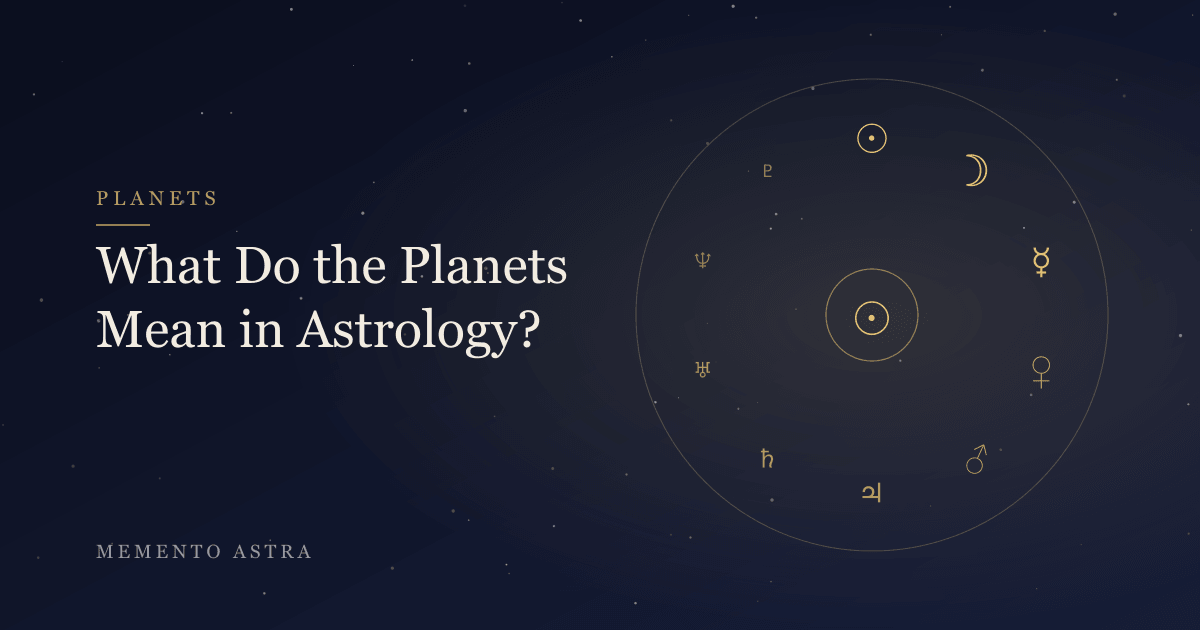
What Do the Planets Mean in Astrology?
All ten planets in your birth chart explained: what each governs, how fast it moves, and why the outer three say almost nothing about you personally.
Signs describe style. Houses describe place. The planets describe function: the actual drives and faculties a chart is made of.
They are also the part of astrology with the clearest internal logic. Once you know what each planet does and how fast it moves, most of a chart interprets itself.
This guide covers all ten: what they govern, how personal they are, and what they mean in each of the twelve signs.
Why "planets" includes the Sun and Moon
Astrology counts ten bodies, and two of them are not planets by any modern definition. The Sun is a star; the Moon is a satellite. Pluto, meanwhile, was reclassified as a dwarf planet in 2006 and astrologers ignored the memo entirely.
The old word explains it. The Greek planētēs means "wanderer": the bodies that move against the fixed background stars. From Earth, all ten do. The category was observational, not astronomical, and astrology never had a reason to update it.
The reclassification question comes up constantly, so: astrology assigns meaning by observed cycle and symbolic tradition, not by mass or orbital clearance. Pluto's redefinition changed its astronomical category and nothing about how astrologers had been reading it for seventy-five years. You can find that unsatisfying, but it is internally consistent.
The three tiers
The single most useful thing to know about the planets is how fast they move, because speed determines how personal a placement is.
| Tier | Planets | Time in one sign | How personal |
|---|---|---|---|
| Personal | Sun, Moon, Mercury, Venus, Mars | Days to weeks | Specific to you |
| Social | Jupiter, Saturn | 1 to 2.5 years | Shared with your cohort |
| Generational | Uranus, Neptune, Pluto | 7 to 20 years | Shared with your whole generation |
This matters because it tells you what to ignore. Everyone born in 1994 has Pluto in Scorpio. It says nothing whatsoever about you as an individual. Its house placement, which depends on your birth time, does.
So: read the sign for the personal planets. Read the house for the generational ones.
The ten planets
☉ Sun: identity
Governs: core self, vitality, purpose, direction of growth Cycle: one sign per ~30 days, full circuit in one year Rules: Leo
The Sun is what you are becoming, not what you already are, which is why people frequently do not recognise their Sun sign until their thirties. Hellenistic astrology treated it as the life-giving principle; modern astrology treats it as the developing self.
Your Sun sign is your "star sign," and it is one placement out of dozens.
☽ Moon: feeling
Governs: emotion, instinct, need, memory, comfort, the mother Cycle: one sign per ~2.5 days, full circuit in ~28 days Rules: Cancer
The fastest-moving body in the chart and the most sensitive to birth time. It travels about half a degree per hour, so a chart cast without a time can easily land it in the wrong sign.
The Moon is your automatic setting: what takes over when you are tired, upset, or frightened. It is not your best self. It is your default one, formed early and largely below conscious control.
☿ Mercury: mind
Governs: thinking, speech, writing, learning, trade, short journeys Cycle: ~2 to 4 weeks per sign Rules: Gemini and Virgo
Mercury never travels more than 28° from the Sun, which means it can only ever be in your Sun sign or one of the two adjacent ones. That constraint is worth knowing. It is why a Capricorn Sun with a Sagittarius Mercury is common and a Capricorn Sun with a Cancer Mercury is impossible.
Mercury retrogrades three or four times a year, which is the one piece of astrology that has escaped into general conversation.
♀ Venus: attraction
Governs: love, beauty, pleasure, values, money, art Cycle: ~3 to 5 weeks per sign Rules: Taurus and Libra
Venus describes what you find attractive and what you consider valuable. The same faculty applied to people and to things. It never travels more than 48° from the Sun, so it stays within two signs either side.
Where Mars pursues, Venus attracts. It is the receptive half of desire.
♂ Mars: drive
Governs: action, assertion, anger, courage, appetite, conflict Cycle: ~6 to 7 weeks per sign, longer when retrograde Rules: Aries (and traditionally Scorpio)
Mars is how you go after what you want, and how you fight when you have to. It describes your relationship with anger, including whether you are able to have any.
The last of the personal planets, and the boundary of the individual layer of the chart.
♃ Jupiter: expansion
Governs: growth, meaning, belief, luck, abundance, excess Cycle: ~1 year per sign, 12-year circuit Rules: Sagittarius (and traditionally Pisces)
Traditionally the "greater benefic", the most fortunate planet in the chart. Modern astrology reads it more carefully: Jupiter enlarges whatever it touches, and enlargement is not automatically good. Jupiter in the 2nd house can mean wealth or it can mean spending.
Its 12-year cycle means your Jupiter return, Jupiter back where it started, lands at roughly 12, 24, 36, 48, 60. Traditionally periods of expansion and opportunity.
♄ Saturn: structure
Governs: limits, discipline, time, responsibility, fear, mastery Cycle: ~2.5 years per sign, 29.5-year circuit Rules: Capricorn (and traditionally Aquarius)
Traditionally the "greater malefic," and traditionally the one people dreaded. Modern astrology has rehabilitated it considerably: Saturn is where the work is, and therefore where genuine competence comes from. Nothing Saturn gives arrives early or free.
The Saturn return (around ages 29, 58, and 88) is the best-known transit in astrology, and the first one has a reputation for arriving as a reckoning. Careers end, relationships end, and something more durable is usually built on the other side.
Saturn is also the last planet visible to the naked eye, which made it the boundary of the known cosmos for most of astrology's history. Everything beyond it is a modern addition.
♅ Uranus: disruption
Governs: sudden change, invention, rebellion, independence, awakening Cycle: ~7 years per sign, 84-year circuit Discovered: 1781 Rules: Aquarius (modern)
The first planet discovered by telescope, found in the decade of the American and French revolutions. A coincidence astrologers have never stopped mentioning.
Uranus breaks things open. Its transits correlate with the abrupt and the unasked-for. Its 84-year cycle produces the Uranus opposition around age 42, the midlife crisis, in astrological terms.
♆ Neptune: dissolution
Governs: imagination, dreams, spirituality, illusion, compassion, escape Cycle: ~14 years per sign, 165-year circuit Discovered: 1846 Rules: Pisces (modern)
Neptune dissolves boundaries: between self and other, real and imagined, sacred and ordinary. At its best it produces art, mysticism, and genuine compassion. At its worst, self-deception, addiction, and a slow inability to see a situation clearly.
Its house placement is where you are most likely to be idealistic and least likely to be accurate.
♇ Pluto: transformation
Governs: power, compulsion, buried things, destruction and rebirth Cycle: 12 to 31 years per sign, 248-year circuit Discovered: 1930 Rules: Scorpio (modern)
The slowest and most extreme. Pluto's house shows where a life is subject to total transformation, where things are destroyed and rebuilt rather than adjusted.
Its orbit is highly eccentric, so it spends wildly different amounts of time in different signs: about 12 years in Scorpio, over 30 in Taurus. Pluto entered Aquarius in 2023 to 24 for a roughly twenty-year stay.
Pluto is also the natural ruler of the 8th house, which is why it comes up constantly in death astrology. See The 8th House.
Common myth: "The planets influence you physically." They do not, and the physics is not close. The gravitational pull of Mars on a newborn is smaller than that of the building they are born in. Astrology is a symbolic system: it treats the sky as a set of meanings, in the way a myth or a tarot card carries meaning. That is a defensible thing to find useful. The physical-force version is not, and you should be sceptical of anyone selling it.
The planets through the signs
A quick-reference for how each planet expresses in each element. For a specific placement, combine the planet's function with the sign's style.
| Planet | In fire signs | In earth signs | In air signs | In water signs |
|---|---|---|---|---|
| Sun | Becomes itself through action | Through building something | Through ideas and people | Through feeling and depth |
| Moon | Needs movement and expression | Needs stability and the physical | Needs to talk it through | Needs depth and safety |
| Mercury | Thinks fast, speaks first | Thinks concretely, slowly | Thinks abstractly, fluently | Thinks associatively, by feel |
| Venus | Loves boldly and quickly | Loves durably and physically | Loves through conversation | Loves totally and porously |
| Mars | Direct, immediate, hot | Persistent, slow, unstoppable | Argues rather than fights | Indirect, tidal, hard to read |
| Jupiter | Grows through risk | Grows through accumulation | Grows through knowledge | Grows through compassion |
| Saturn | Disciplines the impulse | Disciplines the material | Disciplines the thinking | Disciplines the feeling |
Combine that with the house, where it happens, and you have a complete placement. The formula is always the same: planet + sign + house, in that order.
Rulerships
Each sign is governed by a planet. This is one of the oldest structures in astrology and it is what lets a chart cohere rather than reading as ten separate facts.
| Sign | Traditional ruler | Modern ruler |
|---|---|---|
| Aries | Mars | Mars |
| Taurus | Venus | Venus |
| Gemini | Mercury | Mercury |
| Cancer | Moon | Moon |
| Leo | Sun | Sun |
| Virgo | Mercury | Mercury |
| Libra | Venus | Venus |
| Scorpio | Mars | Pluto |
| Sagittarius | Jupiter | Jupiter |
| Capricorn | Saturn | Saturn |
| Aquarius | Saturn | Uranus |
| Pisces | Jupiter | Neptune |
The traditional scheme is elegantly symmetrical: the Sun and Moon take one sign each, and the five visible planets take two apiece, one on each side. The modern additions broke that symmetry to give Uranus, Neptune, and Pluto homes. Many contemporary astrologers use both, reading the traditional ruler for how something operates and the modern one for what it transforms.
Rulership is what makes the chart ruler technique work: find your rising sign, find its ruler, and that planet's placement carries extra weight throughout your chart.
Retrograde planets
A planet is retrograde when it appears, from Earth, to move backwards through the zodiac. It is an optical effect of relative orbital speeds, nothing actually reverses.
Every planet except the Sun and Moon goes retrograde. Mercury does it three or four times a year for about three weeks; the outer planets spend roughly 40% of the time retrograde, which is why a natal retrograde outer planet is unremarkable.
Natally, a retrograde planet is generally read as turned inward. Its function operates more privately, more reflectively, and often less easily in the outside world. Natal Mercury retrograde is common (about one person in five) and is usually read as a mind that processes internally before speaking rather than as any kind of deficit.
By transit, retrogrades are read as review periods for that planet's business. Mercury retrograde's reputation for chaos is heavily overstated and mostly a product of confirmation bias, but it is a reasonable prompt to re-read the contract before signing it.
Frequently asked questions
Why isn't Earth in the chart? Because you are standing on it. A geocentric chart measures everything as seen from Earth, so Earth is the vantage point rather than an object in view. Its position would always be exactly opposite the Sun.
What about Chiron, Lilith, and the asteroids? Chiron (discovered 1977, the "wounded healer") and the lunar nodes are the most widely used additions, followed by asteroids like Ceres, Pallas, Juno, and Vesta. They add nuance. Leave them until the ten core bodies are solid, adding them early is the fastest way to lose the thread of a chart.
Which planet is most important in my chart? Three candidates: the Sun (identity), the Moon (emotional life), or your chart ruler: the planet ruling your Ascendant. In practice, whichever is most tightly aspected or closest to an angle tends to dominate.
Why do the outer planets matter if everyone shares them? Because of their houses, and their aspects to your personal planets. Everyone born in 1988 has Neptune in Capricorn. Only you have it in your 7th house squaring your Sun.
Does Pluto still count now it's a dwarf planet? Astrologers say yes. The 2006 reclassification was an astronomical decision about orbital criteria; astrological meaning is assigned by observed cycle and tradition. It is a fair thing to raise as a criticism of the whole system, but within the system, Pluto's status never depended on the IAU.
Do planets mean the same thing in a death chart? The functions are the same; the reading is not. In a death chart, the Moon reads as emotional tone rather than emotional need, Saturn as completion rather than discipline, Pluto as the transformation itself rather than a lifetime's transformative theme. Same vocabulary, different tense.
Next steps
- Cast your birth chart: all ten planets, with signs, houses, and aspects.
- What Is a Birth Chart?: how the planets fit the whole.
- How to Read Your Birth Chart: the order to read them in.
- The 12 Houses, Explained: where each planet does its work.
Ten functions, twelve styles, twelve arenas. Every chart ever cast is a different arrangement of the same thirty-four pieces.