Your Big Three: Sun, Moon and Rising Explained
Your Sun, Moon and Rising signs do most of the work in a birth chart. What each one governs, why they contradict each other, and how to read all three.
If you learn nothing else about your birth chart, learn these three.
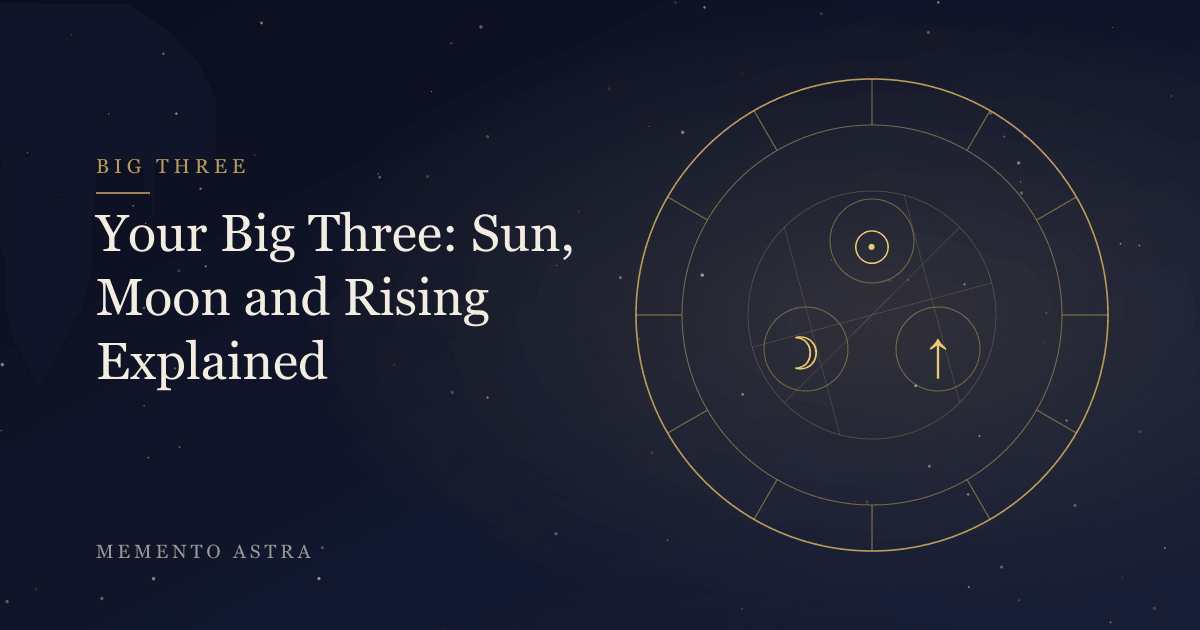
Your Sun, Moon, and Rising signs, the "Big Three", carry most of the interpretive weight in a natal chart. Not because the other placements are decorative, but because these three describe the three different layers a person actually operates on: who you are becoming, what you feel, and how you come across.
Most people know only the first. That is why astrology so often feels like a description of someone else.
The three-layer model
The clearest way to hold it:
| Placement | Governs | The question it answers |
|---|---|---|
| Sun ☉ | Core identity, purpose, vitality | Who am I becoming? |
| Moon ☽ | Emotions, instincts, needs, comfort | What do I feel and need? |
| Rising (Ascendant) | Outward manner, first impressions, approach | How do I meet the world? |
Or, more bluntly:
- Sun: who you are when nobody is watching and nothing is required.
- Moon: who you are at 3am, upset, with no audience.
- Rising: who a stranger thinks you are after ten minutes.
These are genuinely different things, and the everyday assumption that a person has one consistent "personality" is exactly what the Big Three complicates. You are not being fake when the three do not match. You are being three-layered, which is the normal condition.
Did you know? Roughly one person in twelve has their Sun, Moon, and Rising in the same sign, and it is unmistakable when you meet them. What you see really is what there is, all the way down. The other eleven-twelfths of us are running some kind of internal negotiation.
The Sun: who you are becoming
Your Sun sign is the one you already know. It is the sign the Sun occupied at your birth, determined by your birth date alone, and it changes roughly every 30 days.
The Sun in a chart represents core identity, vitality, and direction of growth. The important nuance, and the one that makes Sun-sign horoscopes so unsatisfying, is that the Sun describes something you are moving toward rather than something you already are. Hellenistic astrology treated it as the life-giving principle; modern psychological astrology treats it as the developing self.
This is why people often do not recognise their Sun sign description in their twenties and recognise it completely in their forties.
| Sun sign | Becoming... |
|---|---|
| Aries | Someone who acts first and apologises later, and means both |
| Taurus | Someone steady enough that other people build around them |
| Gemini | Someone genuinely curious rather than merely quick |
| Cancer | Someone who protects without smothering |
| Leo | Someone generous with their own warmth, not just their own light |
| Virgo | Someone useful in a way that costs them something |
| Libra | Someone fair even when it is inconvenient |
| Scorpio | Someone who can look directly at hard things |
| Sagittarius | Someone who keeps the horizon open for others too |
| Capricorn | Someone reliable at scale and over time |
| Aquarius | Someone principled rather than merely contrary |
| Pisces | Someone compassionate without dissolving into it |
Your Sun also sits in a house, which is where that development happens. Sun in the 10th builds identity through career and public life; Sun in the 4th builds it through home and family. If you know your birth time, the house is at least as informative as the sign.
The Moon: what you feel
The Moon is the fastest-moving body in the chart, changing sign roughly every two and a half days. Its position is genuinely sensitive to birth time. The Moon travels about half a degree per hour, so a noon-default chart can put it in the wrong sign entirely if you were born near a boundary.
The Moon governs emotion, instinct, memory, and need. Where the Sun is conscious and forward-looking, the Moon is reflexive and backward-looking. It is your default emotional setting, the shape of your comfort, and the thing that takes over when you are tired, frightened, or hurt.
It is also, traditionally, the mother and the childhood home, the emotional climate you were formed in.
| Moon sign | Feels safe when... | Struggles with... |
|---|---|---|
| Aries | Something is being done about it | Sitting with a feeling |
| Taurus | Things are physical, calm, unhurried | Sudden change |
| Gemini | It can be talked through | Feelings without words |
| Cancer | Home and people are close | Letting go of anything |
| Leo | It is seen and taken seriously | Feeling overlooked |
| Virgo | There is a useful task | Chaos it cannot fix |
| Libra | The room is harmonious | Open conflict |
| Scorpio | Trust is total or absent | Half-measures, being managed |
| Sagittarius | There is room and a wider view | Feeling trapped |
| Capricorn | It is under control | Needing help |
| Aquarius | It can step back and analyse | Emotional demands |
| Pisces | It can retreat and imagine | Hard boundaries |
Your Moon sign is often the placement people recognise most immediately once they hear it, usually with slight embarrassment. That is the correct response. The Moon is not your best self; it is your automatic one.
The Rising sign: how you meet the world
Your Rising sign (properly, the Ascendant) is the zodiac sign that was climbing over the eastern horizon at the exact moment and place of your birth.
Because the Earth rotates once every 24 hours, the Ascendant moves through all twelve signs every day, changing roughly every two hours. This is the placement that makes birth time non-negotiable. Two people born the same day in the same city, four hours apart, share a Sun sign and possibly a Moon sign, and present to the world completely differently.
The Ascendant governs outward manner, first impressions, physical bearing, and instinctive approach. It is not a mask in the deceptive sense. It is the interface: the part of you that handles arrivals, introductions, and unfamiliar rooms.
It also does something structural that the Sun and Moon do not: the Ascendant sets your entire house system. Your 1st house begins at the Ascendant, and every other house follows from it. Change the Rising sign and every planet in your chart lands in a different house. It is the single most consequential placement in the wheel.
| Rising sign | Reads as... |
|---|---|
| Aries | Direct, quick, a little combative even when friendly |
| Taurus | Calm, unhurried, physically settled |
| Gemini | Talkative, curious, quick to make contact |
| Cancer | Warm but guarded; takes time to open |
| Leo | Warm, noticeable, naturally centre-stage |
| Virgo | Precise, observant, slightly reserved |
| Libra | Charming, agreeable, difficult to argue with |
| Scorpio | Intense, private, hard to read |
| Sagittarius | Open, blunt, immediately informal |
| Capricorn | Composed, serious, older than their age |
| Aquarius | Friendly but detached; slightly outside the group |
| Pisces | Gentle, receptive, hard to pin down |
Your chart ruler, the planet ruling your Rising sign, becomes the most important planet in your chart. Scorpio rising means Mars (and Pluto) carry extra weight wherever they sit. This is one of the oldest techniques in astrology and one of the most useful.
We cover this placement in full in What Is a Rising Sign?
Reading all three together
The real skill is in the combination. Take three examples.
Leo Sun, Capricorn Moon, Virgo Rising
Presents as precise and quietly competent (Virgo rising). Emotionally self-contained, dislikes needing anyone (Capricorn Moon). But underneath, genuinely wants to be seen, for the work to be noticed, for the contribution to be named (Leo Sun).
The tension: the Leo need for recognition never gets expressed, because both the Rising and the Moon consider asking for it undignified. This person does excellent work and quietly resents that nobody mentions it. Naming that pattern is worth more than any single placement.
Pisces Sun, Aries Moon, Capricorn Rising
Reads as serious, contained, professionally solid (Capricorn rising). Reacts to distress by doing something immediately (Aries Moon). Impatience is the first emotional gear. Yet the underlying identity is imaginative, permeable, and drawn toward meaning rather than achievement (Pisces Sun).
The tension: two of the three layers are structural and fast, and the actual self is neither. This is the person who builds a very solid career and, at forty, cannot explain why it does not feel like theirs.
Gemini Sun, Gemini Moon, Sagittarius Rising
Nearly aligned: Sun and Moon in the same sign, Rising in its opposite. Curious, verbal, quick, restless, all the way through (double Gemini). Comes across as expansive and blunt (Sagittarius rising).
There is very little internal contradiction here, which is its own issue: no counterweight. Nothing in the Big Three slows this person down or asks them to stay. Whatever provides ballast will have to come from elsewhere in the chart. Saturn's placement is the first thing to check.
Expert tip: read for the contradiction first. When you look at a set of Big Three, do not summarise each in turn. Find where two of them disagree and describe that. The disagreement is where the person actually lives, and it is the part no Sun-sign horoscope will ever tell them.
How to find yours
You need your birth date, birth time, and birthplace. Date alone gives you the Sun. Date and time give you the Moon reliably. All three give you the Ascendant.
Cast your chart here. It takes about thirty seconds and returns all three, plus the rest of the wheel.
If you do not know your birth time: you can still get your Sun, and usually your Moon. Cast for 12:00 noon; if the Moon changes sign that day, you will need the time to be sure. The Ascendant is not recoverable without it. Long-form birth certificates often list the time. Short-form ones usually do not.
Frequently asked questions
Which of the Big Three is most important? It depends what you are asking. For identity and long-term development, the Sun. For emotional life and relationships, the Moon. For how you actually move through the world day to day, the Rising, and structurally, the Ascendant matters most of all, because it determines every house placement in the chart.
Why don't I relate to my Sun sign? Three usual reasons. Your Rising and Moon may be doing most of the visible work. Your Sun may be in a house that reshapes how it expresses. Or you are simply young. The Sun describes a direction of growth, and it is common not to recognise it until your thirties.
Can my Moon and Rising be the same sign? Yes, and it produces a notably congruent person: what they show is what they feel. It happens for anyone born around moonrise.
What if my birth time is off by an hour? Your Ascendant may be wrong. It moves about one degree every four minutes, so an hour is roughly half a sign, usually still correct, but not if you were born near a cusp. If two Rising descriptions both sound plausible, that is the likely explanation. Astrologers use a technique called rectification to narrow it down from life events.
Is "Rising sign" the same as "Ascendant"? Yes. Same placement, two names. Older texts prefer Ascendant; modern popular astrology prefers Rising.
What about my "Big Six"? Some astrologers extend to Mercury, Venus, and Mars: mind, values, and drive. It is a reasonable next step once the first three are solid, and it fills in the specifics the Big Three leave vague. See what the planets mean.
Do the Big Three appear in a death chart too? They do, and they read very differently. In a death chart, the Ascendant is not "how this person met the world" but what was rising as a life closed. Same three placements, entirely different question. We cover the distinction in death chart vs birth chart.
Next steps
- Cast your birth chart: get all three in under a minute.
- What Is a Birth Chart?: the full picture the Big Three sit inside.
- What Is a Rising Sign?: the most underrated of the three.
- The 12 Houses, Explained: where all of this actually happens.
Three signs, three layers, one person. The interesting part was never any one of them. It is the argument between them.