The 8th House: Death, Endings and Transformation
Astrology's house of death, inheritance and intimacy. What the 8th house really means in your chart, sign by sign and planet by planet, and why it is misread.
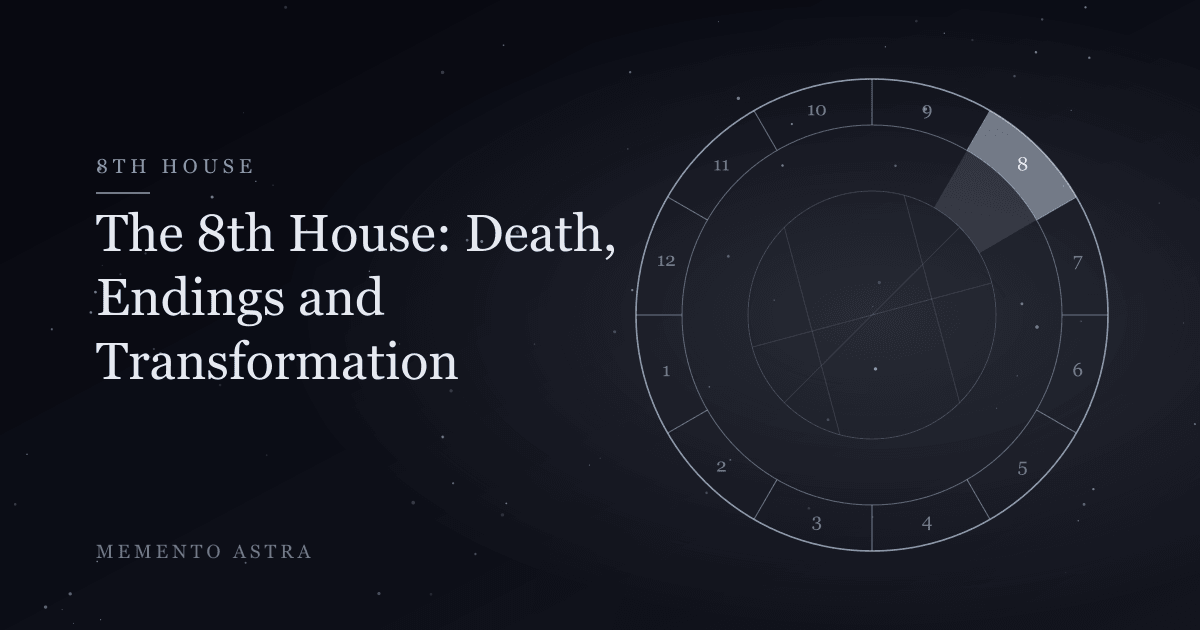
Every astrology beginner hits the 8th house and flinches. It is the one labelled death.
Then they read a modern interpretation and find it has been quietly redecorated: intimacy, shared finances, psychological depth, "transformation." All accurate. All also, in a way, an evasion, because the house did originally mean death, and it still does, and the tradition was not being morbid when it said so.
This is a guide to reading the 8th house without either flinching or pretending. It covers what the house actually governs, how each sign and planet behaves in it, why it is the most misread house in the wheel, and what it looks like in a death chart rather than a birth chart.
What the 8th house governs
The classical name, from the Hellenistic tradition, is Mors, death. Its modern remit is wider, and the wider version is not a euphemism; it is a recognition of what the older astrologers were already pointing at.
The 8th house governs:
- Death, dying, and the dead. Mortality as a fact, and your relationship to it.
- Inheritance and legacy. What is passed on. Wills, estates, bequests, and the non-material versions.
- Other people's money. Shared finances, debt, tax, insurance, investment, anything held jointly.
- Sexual intimacy. Not attraction (that is the 5th and the 7th) but the merged, exposed kind.
- Transformation and crisis. The processes you do not survive unchanged.
- The hidden and the taboo. Secrets, buried material, what a family does not discuss.
- Occult and depth work. Therapy, research, investigation, anything that goes looking underneath.
The thread running through all of it: the 8th house is about what you cannot hold alone.
Look at the list again with that in mind. Death is the ultimate loss of control. Inheritance is value that arrives from someone else's ending. Shared money is resources you do not unilaterally command. Sexual intimacy is the deliberate lowering of a boundary. Crisis is change happening to you rather than by your design. Every 8th house subject involves a merger, a surrender, or a transfer.
This is why the "death house" framing and the "intimacy and shared resources" framing are not two different interpretations. They are the same principle at different intensities.
Did you know? The 8th house sits directly opposite the 2nd: the house of your money, your possessions, your self-worth. That axis is the whole story: what is mine versus what is ours, what I hold versus what I hand over. You cannot really read one end without the other.
Why it sits where it does
The house order is not arbitrary, and the 8th makes far more sense once you see the sequence it belongs to.
The wheel runs from self-definition at the 1st house outward. By the 7th you have met another person as an equal: partnership, marriage, the acknowledged other. The 8th is what happens after that meeting: the point where two separate lives become genuinely entangled. Joint accounts. Shared risk. Each other's debts and secrets and eventual deaths.
The 7th is meeting someone. The 8th is what it costs.
And it sits just before the 9th house of meaning, belief, and philosophy, which is exactly the right order. Encounters with mortality and loss are what push most people to ask the 9th house questions in the first place.
The 8th house through the twelve signs
The sign on your 8th house cusp describes how you meet these subjects: your instinctive posture toward loss, sharing, and depth. Read this alongside the planet that rules that sign, and where it sits in your chart.
Aries on the 8th: Meets crisis head-on and at speed. Confronts mortality rather than avoiding it, sometimes recklessly. Struggles with the parts of loss that cannot be done, only endured.
Taurus on the 8th: Wants endings to be slow, tangible, and dignified. Deeply attached to physical inheritance and to what remains. The difficulty is release: holding on well past the point where holding on helps.
Gemini on the 8th: Processes loss by talking, reading, researching, explaining. Often the person who handles the practical aftermath with startling competence, and grieves eighteen months later.
Cancer on the 8th: Grief runs through family and memory. Intensely protective of the dead. Ancestral material, what a family carries and does not say, is unusually live here.
Leo on the 8th: Endings need meaning and ceremony. The instinct is toward the fitting tribute, the good funeral, the story told properly. Legacy is a real, felt concern rather than an abstraction.
Virgo on the 8th: Copes through usefulness. Handles the admin, the paperwork, the care work. The risk is mistaking the completed checklist for the completed feeling.
Libra on the 8th, Approaches death and shared resources through fairness, who gets what, who was owed what. Family estates and their inequities land hard. Wants endings to be balanced, and they rarely are.
Scorpio on the 8th: The house in its own sign. Unflinching, and drawn to what others avoid. Intimacy is all-or-nothing; there is little interest in the shallow end. Little patience for euphemism about death.
Sagittarius on the 8th: Meets mortality philosophically. Reaches for the wider frame: faith, meaning, the long view. At its best, genuinely consoling; at its worst, a way of skipping past the grief itself.
Capricorn on the 8th: Sober, responsible, structural. Often the executor. Handles death as duty and holds it together for everyone else, frequently at real private cost.
Aquarius on the 8th: Steps back and takes the wide view. Detachment as a survival strategy. Sometimes clear-sighted, sometimes a way of watching your own grief from a distance rather than having it.
Pisces on the 8th: Boundaries are thin here. Absorbs other people's grief as if it were personal, and it may not be clear where one ends and the other begins. Strong pull toward the mystical and the dream-adjacent.
Planets in the 8th house
A planet in the 8th brings its function into this territory. These placements tend to be significant in a life whether or not the person has ever thought about astrology.
Sun in the 8th: Identity is forged through crisis and depth. These people usually cannot do a shallow life; something in them requires the real thing. Often marked early by a death or major loss that shaped who they became.
Moon in the 8th: Emotional life runs deep and largely underground. Powerful intuition about what is unspoken in a room. Comfort is found in intensity rather than ease, which can be hard to explain to people who want a lighter version of you.
Mercury in the 8th: A mind that investigates. Research, psychology, forensics, anything requiring the removal of a surface. Talks about what others will not, and is either enormously valued or quietly resented for it.
Venus in the 8th: Love is not casual. Attraction runs toward depth, complexity, and sometimes danger. Money frequently arrives through partnership or inheritance rather than salary.
Mars in the 8th: Considerable stamina in crisis. Handles emergencies with a steadiness other people find inexplicable. Conflict over shared resources (money, property, estates) is a recurring theme.
Jupiter in the 8th: Classically a good placement for inheritance and shared resources. More interestingly: an unusual capacity to find meaning in loss. Not denial, meaning.
Saturn in the 8th: Fear of death, or a long, serious, unavoidable reckoning with it. Early responsibility for someone else's ending is common. Slow, structural work around trust and control. Often gets substantially easier after Saturn's return.
Uranus in the 8th: Sudden, unpredictable endings. Loss arriving without warning. An unorthodox relationship to death, and often a refusal to grieve in the socially approved manner.
Neptune in the 8th: The boundary between self and other, living and dead, is porous. Strongly drawn to the mystical dimension of death. Also the placement most prone to self-deception about shared money. Read the contract.
Pluto in the 8th: Its own house, its own sign's ruler. Total transformation as a life pattern. Power dynamics around control, secrecy, and intimacy that take decades to work through. Nothing here is done by halves.
Common myth: "Planets in the 8th house mean an early death." No. This has never been a responsible reading, and no ethical astrologer works this way. The 8th house describes a relationship to mortality, loss, and shared life, not a timeline. Charts do not contain expiry dates, and anyone claiming to read one from yours is doing something both unfounded and cruel. We go into this properly in Can Astrology Predict Death?
An empty 8th house
Most charts have empty houses. With ten planets and twelve houses, at least two are always vacant, and there is nothing wrong with that.
An empty 8th does not mean you will not experience loss, intimacy, or transformation. It means those subjects are not where your chart's stated emphasis falls. To read it anyway:
- Find the sign on the 8th house cusp.
- Find that sign's ruling planet.
- Find where that planet sits.
If Pisces is on your 8th cusp and Neptune sits in your 10th, your 8th house business tends to surface through career and public life. The house is never truly empty. Its business is simply conducted elsewhere.
The 8th house in a death chart
Everything above assumes a birth chart. A death chart, the same astrology cast for the moment a life ended rather than began, changes what the 8th house is doing.
In a natal chart, the 8th describes a lifelong relationship with endings: how this person will meet loss, hold shared things, go into depth. It is a disposition.
In a death chart, the 8th house is describing the moment itself. It is no longer a theme in a life; it is the frame around a completed one. What sits there, what sign holds the cusp, whether the Moon or the chart ruler falls into it. These describe the texture of an ending that has already happened.
That is a very different reading, and it asks for a different posture. A natal 8th house reading is exploratory: here is something you might work with. A death chart reading is commemorative: here is a shape, already finished, offered for reflection.
It makes no claims about cause. It predicts nothing. There is nothing left to predict. It is a way of looking at a life's final alignment with the same attention we give the first one. If that framing means something to you, memorial astrology covers it in full.
Reading your own 8th house
A practical sequence:
- Open your chart and find the 8th house. It is the fifth segment counter-clockwise from the Descendant.
- Note the sign on the cusp. That is your instinctive posture toward everything above.
- Note any planets in it. These are the loud voices.
- Find the cusp sign's ruler and where it lives. Especially important if the house is empty.
- Look at the 2nd house too. The axis only makes sense read as a pair, what you hold against what you share.
- Then ask the honest questions. How do you handle things you cannot control? What did your family not talk about? Where does your money actually come from? What have you inherited that is not money?
The last step is the one that matters. The rest is scaffolding.
Frequently asked questions
Is the 8th house always bad? No. The good/bad framing belongs to a much older, more fatalistic astrology and has largely been abandoned. The 8th is demanding. Its subjects are ones nobody chooses. Demanding is not the same as bad, and most people's genuine depth comes from exactly here.
Which planet rules the 8th house? Traditionally Mars, as ruler of Scorpio. In modern astrology, Pluto, assigned to Scorpio after its 1930 discovery. Many practising astrologers use both: Mars for how you act on it, Pluto for what is being transformed.
What if I have a stellium in the 8th? Three or more planets there makes it a defining feature of the chart. Depth, crisis, intimacy, and shared resources will be persistent life themes rather than occasional visitors. Often present in therapists, researchers, hospice workers, funeral directors, insurers, and investigators.
Does the 8th house predict how I'll die? No. It is not used that way by anyone reading responsibly. See the myth callout above.
Why do some charts put my planets in a different house? House systems divide the wheel differently. A planet in the 8th under Placidus can land in the 7th or 9th under Whole Sign. Both are legitimate; check which system your chart uses before concluding anything.
What's the difference between the 8th and the 12th house? Both deal with the hidden, and they get confused constantly. The 8th is about merging. What happens between you and another. The 12th is about dissolution. What happens when the self quietly comes apart. The 8th is shared; the 12th is solitary.
Where to go next
The 8th house is where astrology stops being a personality quiz. It is the part of the chart that takes mortality seriously, which is precisely why we built a site around it.
- What Is a Death Chart?: the same astrology, cast for an ending.
- The 12 Houses, Explained: the full wheel, in order.
- Memorial Astrology: using a chart as an act of remembrance.
- Cast your birth chart: and go and look at your own 8th house.
The house of death is not, in the end, about dying. It is about everything you cannot keep, and what you become in the process of letting it go.