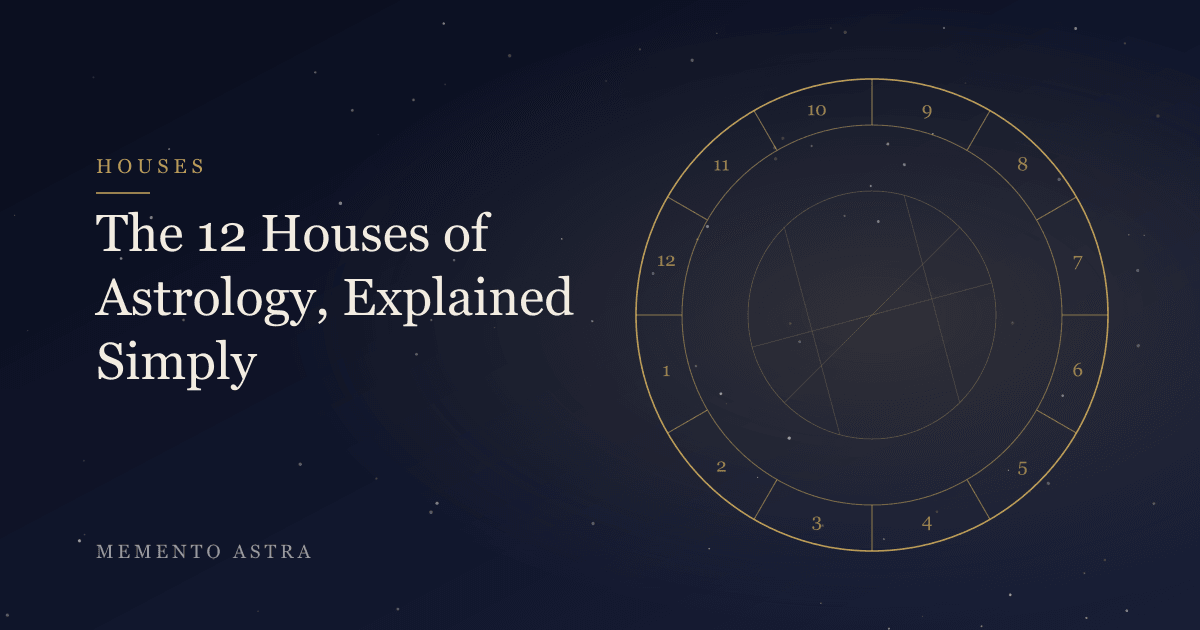
The 12 Houses of Astrology, Explained Simply
Houses are where astrology stops being vague. What each of the twelve governs, how to read an empty one, and why two chart calculators can disagree.
Succedent house · Lucrum
The second house covers what you own and what you earn, and the tradition extends that to what you value in yourself. Money and self-worth are treated as the same subject here, which sounds like a modern reframing and is actually very old.
| Governs | Money, possessions and self-worth |
|---|---|
| Traditional name | Lucrum |
| Type | Succedent |
| Associated sign | Taurus and Venus, by analogy |
| Opposite house | The 8th, shared resources, intimacy, death and what is hidden |
The houses that follow the angles. Read as consolidation: what gets held, kept and built on after something has been started.
In a profection year, this is the house that runs the whole year: the 2nd takes over at the birthdays when you turn 1, 13, 25 and every twelve years after.
Read as the house of resources in the broadest sense: income, possessions, and the sense of having enough. A difficult second house is not read as poverty but as a relationship with security that takes work, whatever the actual balance says.
A planet here describes how you acquire and hold. Saturn in the second is the classic placement for somebody careful with money and privately convinced there is never quite enough; Jupiter here is the opposite problem, an ease with money that runs slightly ahead of the amount of it.
An empty second house is not a prediction of poverty. It means money is not a defining theme of the chart, which most people would consider good news.
There are ten planets and twelve houses, so at least two are always empty and usually more like six. An empty house is the normal case, not a deficiency, and the sign on its cusp carries the reading instead.
What a planet does here, one page each. A planet says what, the house says where in a life it happens.
Your Sun sign depends only on the date. Your houses depend on the horizon at the moment you were born, and the whole framework rotates by one house roughly every two hours. An hour of error moves half of it.
This is why a Sun-sign horoscope cannot use real houses. It counts them from your Sun sign instead, which is a genuine traditional technique called the solar chart and is an approximation. This site uses it for the daily, weekly and monthly readings and says so on each of them; the transit calculator uses your real houses when you give it a time, and withholds them when you do not.
The same is true of where you were. A horizon is fixed by a moment and a place, so the 2nd house is drawn around the one you were standing on. Read the same chart from another city and every planet stays at the identical degree while the houses are rebuilt around a different horizon, which is what a relocation chart shows.
The chart is free and computes all twelve from your birth time, alongside every planet, the lunar nodes and Chiron.
Houses are where astrology stops being vague. What each of the twelve governs, how to read an empty one, and why two chart calculators can disagree.
A seven-step method for reading a natal chart from scratch: what to look at first, what to ignore, and how to turn symbols into an actual person.
A birth chart maps the sky at the exact moment you were born. Here is what every part of it means, and how to read yours from scratch, no jargon.
The two that come up most.
An empty second house is not a prediction of poverty. It means money is not a defining theme of the chart, which most people would consider good news.
Yes. The houses are fixed to the horizon at your birth moment, and the whole framework rotates by one house roughly every two hours. Without a birth time a chart can give you every planet's sign and no houses at all.